

The 5 S Model
The Five S Model is a way of organising the different levels of the social-ecological system across which teacher resilience is shaped. This model has been informed by our research and proposed by our project advisor Sue Beltman. It helps us recognise that resilience is influenced by a wide range of protective and risk factors operating at different levels, rather than sitting solely within the individual teacher.
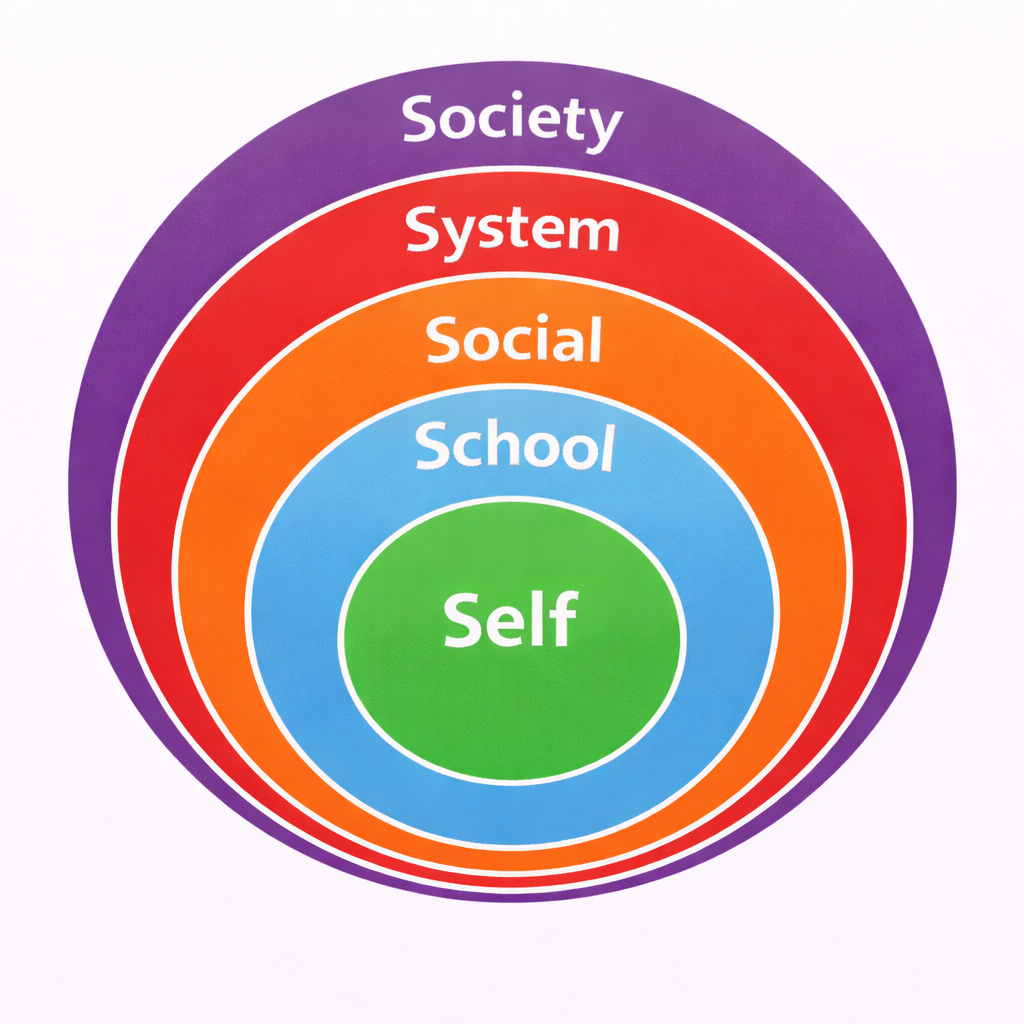
Using this model, we focus on identifying the factors that support teacher resilience across five interconnected levels: Self, School, Social, System, and Society. Together, these levels provide a framework for understanding how resilience develops through the interaction between individuals and their wider contexts.
The Five S Model provides an organising framework that acknowledges how different levels of the social-ecological system can have direct and indirect effects on the teacher resilience process. By considering all five levels together, the model helps to explain how influences on Self, School, Social, System, and Society interact to shape key outcomes of positive adaptation, including teacher wellbeing, burnout, and job satisfaction.
-

Self
Find out more: SelfSelf refers to individual-level influences that shape how teachers experience and respond to challenge. These include factors such as self-esteem, emotional intelligence, personality, optimism, self-care, self-efficacy, independent problem-solving, and investment in pupils.
-
School
Find out more: SchoolSchool captures factors within the immediate working environment. These include support from leadership, workload, pupil behaviour, school culture, and any conflict teachers experience between their professional beliefs and everyday practice.
-

Social
Find out more: SocialSocial relates to the relationships and networks that surround teachers. This includes support from colleagues, as well as support from family and friends, and relationships with parents.
-
System
Find out more: SystemSystem refers to broader structural and policy-level influences on teachers’ work. Examples include curriculum demands, high-stakes assessment and datafication, inspection and accountability processes, provision for pupils with additional needs, and working patterns.
-

Society
Find out more: SocietySociety reflects wider cultural and societal influences on teaching. This includes the broadening role of schools, levels of reward and recognition, and public perceptions of teachers and the profession.